


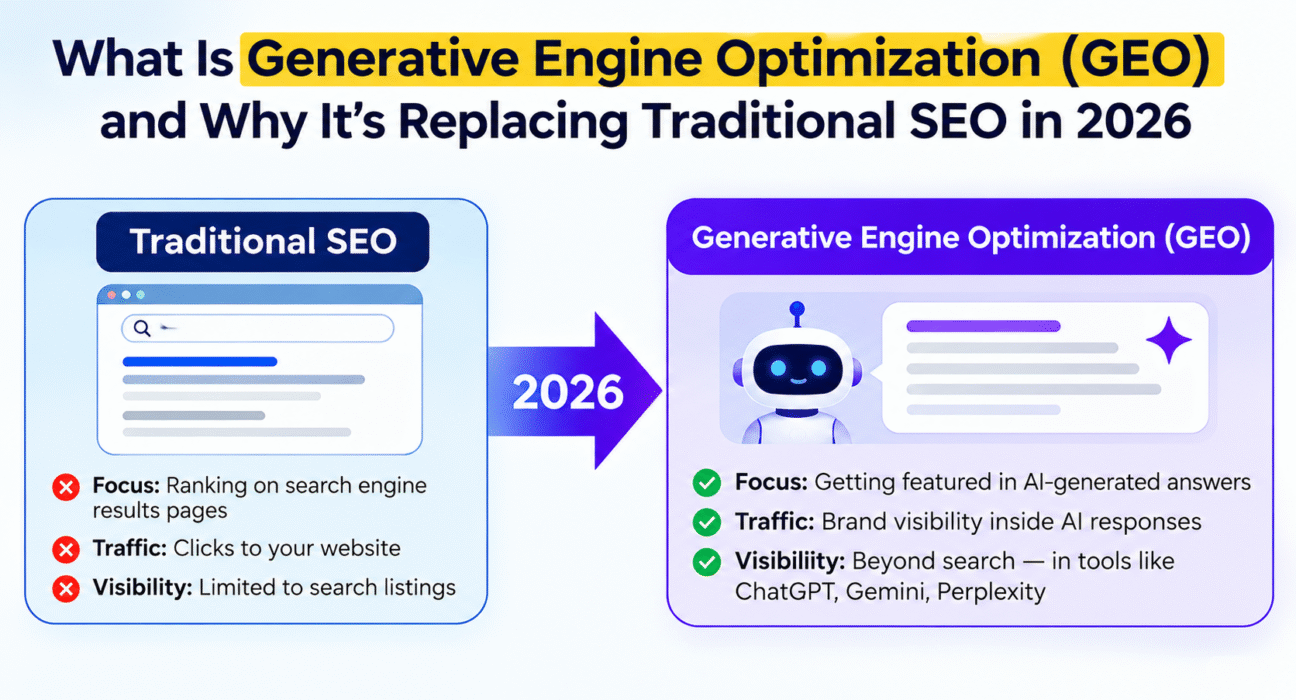
Generative Engine Optimization, or GEO, is the practice of optimizing content and brand presence so that AI systems like ChatGPT, Gemini, and Perplexity include and recommend you in the answers they generate. It’s the natural successor to SEO in a world where a growing share of research and buying decisions happen inside a conversation with an AI assistant, not a list of blue links.
If that sounds like a rebrand of SEO with a new acronym, it isn’t. The mechanics are genuinely different, and the gap between the two is exactly why brands that dominate Google search results can still be invisible when someone asks an AI model the same question. LLM brand visibility tool like Branviz exist specifically to measure that gap.
Table of Contents
What actually is GEO, in plain terms?
SEO optimizes for a ranking algorithm that returns a list of pages. GEO optimizes for a language model that reads across many sources, synthesizes an answer, and decides which brands, if any, are worth naming inside that answer. The output isn’t a page position, it’s a mention, or the absence of one.
That distinction changes almost everything about how the work gets done. With SEO, you can control most of the levers directly: your own page’s title tags, headers, internal links, and backlink profile. With GEO, a meaningful part of your visibility depends on how other sources describe you, because models weigh corroboration across the web rather than trusting a single site’s claims about itself. This is why an LLM brand visibility tool such as Branviz focuses on cross-source corroboration rather than the on-page signals a traditional SEO tool checks.
Why is this replacing traditional SEO rather than sitting alongside it?
“Replacing” is a slight overstatement, and it’s worth being precise here: GEO doesn’t make SEO obsolete, it changes where the marginal dollar of effort produces the most return. Search behavior is shifting. A growing portion of research queries, especially comparison and recommendation queries like “best accounting software for freelancers,” now happen through conversational AI instead of a traditional search box. When that shift happens, the page-one ranking you fought for stops mattering for that slice of traffic, because the user never sees a results page at all. They see a synthesized answer with three or four brand names in it.
Budgets follow behavior. As more enterprise buyers use AI tools for early-stage research, marketing teams are reallocating spend and attention toward making sure their brand is one of the names that shows up, not just one of the top ten links on a results page that fewer buyers are scrolling through.
How do AI models decide who to mention?
Three factors matter most, and none of them are keyword density:
- Frequency of mention. How often does your brand appear alongside your category, across sources you don’t control?
- Clarity of positioning. Does the text plainly state what you do and who it’s for, in language close to how people actually ask questions?
- Corroboration across sources. Do independent publications, review sites, and forums describe you consistently? Models treat agreement across sources as a stronger signal than confident claims from your own site.
This is why a strong backlink profile built purely for SEO doesn’t automatically translate into AI visibility. A hundred links from low-quality directories do very little for either channel, but a handful of genuinely independent, well-written comparison articles can matter enormously for GEO specifically, because they’re exactly the kind of corroborating source a model pulls from.
What does GEO work actually look like day to day?
In practice, GEO splits into three workstreams:
- Technical readiness. Make sure your key pages are crawlable without depending on heavy client-side rendering, carry clear structured data, and state your core value proposition in the first few sentences rather than burying it under brand narrative.
- Third-party presence. Pitch guest content, contribute to comparison roundups, and seek out expert-quote opportunities on independent publications in your niche. The goal is accurate, consistent, fact-based descriptions of your brand appearing in places you don’t own.
- Answer-shaped content. Structure content around the specific phrasing people use when talking to AI assistants: direct questions, FAQ sections, and comparison tables, rather than long narrative copy that buries the answer three paragraphs in.
Can you measure GEO the way you measure SEO?
Yes, though the metrics differ. Instead of tracking keyword rank, GEO tracking looks at:
- Mention rate, how often your brand appears across a set of realistic prompts run against multiple models.
- Share of voice, how you compare to named competitors when a model is asked to recommend options in your category.
- Sentiment and framing, whether the model describes you accurately and favorably when it does mention you.
Purpose-built LLM brand visibility tools like Branviz automate this by running your brand against dozens of prompts across ChatGPT, Gemini, and Perplexity on a recurring basis, which turns “we think we’re not showing up” into a trackable number, the same way rank tracking did for traditional SEO fifteen years ago. Branviz specifically breaks this down by funnel stage, so you can see whether the gap is at awareness or at the decision-stage prompts that actually drive recommendations.
Should you drop SEO spend to fund GEO?
No, and this is the most common mistake teams make when a new channel gets hype. SEO still drives the traffic that arrives through traditional search, and much of the technical foundation, clean structured data, clear page copy, credible third-party mentions, benefits both channels simultaneously. The smarter move is treating GEO as an added measurement layer and content discipline on top of what you’re already doing, not a replacement budget line.
Where the reallocation makes sense is at the margin: the next guest post, the next comparison article pitch, the next round of content briefs. Writing those with an eye toward how an AI model would extract and cite them, clear entities, direct answers, corroborating facts, costs little extra and pays off in both channels at once. Running each new placement through an LLM brand visibility tool like Branviz afterward tells you whether it actually moved your mention rate, rather than assuming it did.
FAQ
Is GEO the same thing as AEO (Answer Engine Optimization)?
The terms overlap heavily and are often used interchangeably. Both describe optimizing for visibility inside AI-generated answers rather than traditional search rankings; some practitioners use AEO specifically for voice and featured-snippet-style answers and GEO for broader generative AI visibility, but the underlying practices are nearly identical.
Does GEO require different content than SEO?
Not entirely different, but it rewards direct answers, clear entity naming, and third-party corroboration more heavily than SEO does, where on-page optimization and backlink volume carry more weight.
How long does it take to see results from GEO efforts?
Because model training and retrieval cycles vary, changes can take anywhere from a few weeks to a few months to show up in AI answers, which is why ongoing tracking with an LLM brand visibility tool like Branviz matters more than a one-time audit.
Do smaller brands have a realistic shot at AI visibility against larger competitors?
Yes, more so than in traditional SEO in some cases, because AI models weigh clarity and corroboration over sheer content volume or domain authority, which gives well-positioned niche brands a genuine opening.
